 Thruster
 supported token swaps on Blast before announcing its wind-down
Thruster was a decentralized exchange on Blast that supported token swaps through V2 and V3 liquidity pools before announcing its wind-down. Its automated market makers, or AMMs, priced trades against pooled assets. V2 positions represented proportional pool shares, while V3 positions used selected price ranges. The project also introduced THRUST, with vote-escrowed veTHRUST used for voting and earning arrangements. Its wind-down announcement addressed token-holder redemption. V2 and V3 liquidity removal also had contract-based methods through Blastscan, with the method tied to the position type. Those methods concerned pool assets, while the announced redemption concerned project-token holdings.
- updatedThe wind-down announcement concerned token-holder redemption, a different matter from removing the underlying assets of V2 or V3 liquidity positions.
Trade Size and Available Liquidity
A swap’s input amount and the pool’s available liquidity shaped its estimated output and exchange rate for the selected pair. Larger trades could experience greater price impact as they consumed more of the liquidity available along the pool’s price curve.
The swap interface also included slippage tolerance, token-spending approval when required, and a review of gas fees. These controls had different purposes. Approval authorized spending; it didn’t itself exchange the tokens. Slippage tolerance limited acceptable execution changes, while gas covered network execution. A completed swap required confirmation on Blast, beyond a displayed estimate or a wallet authorization.
V2 and V3 Liquidity Positions
The pool version changed how liquidity providers committed assets and earned trading fees. Both designs connected pooled assets with swaps, but they represented positions differently.
V2 Full-Range Pool Shares
The classic AMM followed the Uniswap v2 constant-product design, expressed as x × y = k. Here, x and y represented the pool’s asset reserves. Providers supplied the paired assets in equivalent value and received fungible ERC-20 LP tokens representing their proportional exposure. Liquidity covered the full price range, and swap fees accumulated within the pool. The documented asset scope covered fungible, non-rebasing ERC-20 tokens with available pool liquidity. Pool creators could establish new pairs permissionlessly within that supported asset scope. Price changes could produce impermanent loss, a shortfall relative to holding the deposited assets separately.
V3 Selected Price Ranges
The concentrated-liquidity AMM drew on Uniswap v3 and let providers select a price interval. This concentrated available liquidity around prices where trades could occur. A position outside its interval stopped participating in trades and earning trading fees. Outside the range, its remaining liquidity consisted of a single asset. The position became active again when the price re-entered its range; providers could also reposition liquidity in a new range. Concentrating liquidity changed where assets worked, without removing their exposure to price movements.
THRUST and the veTHRUST Model
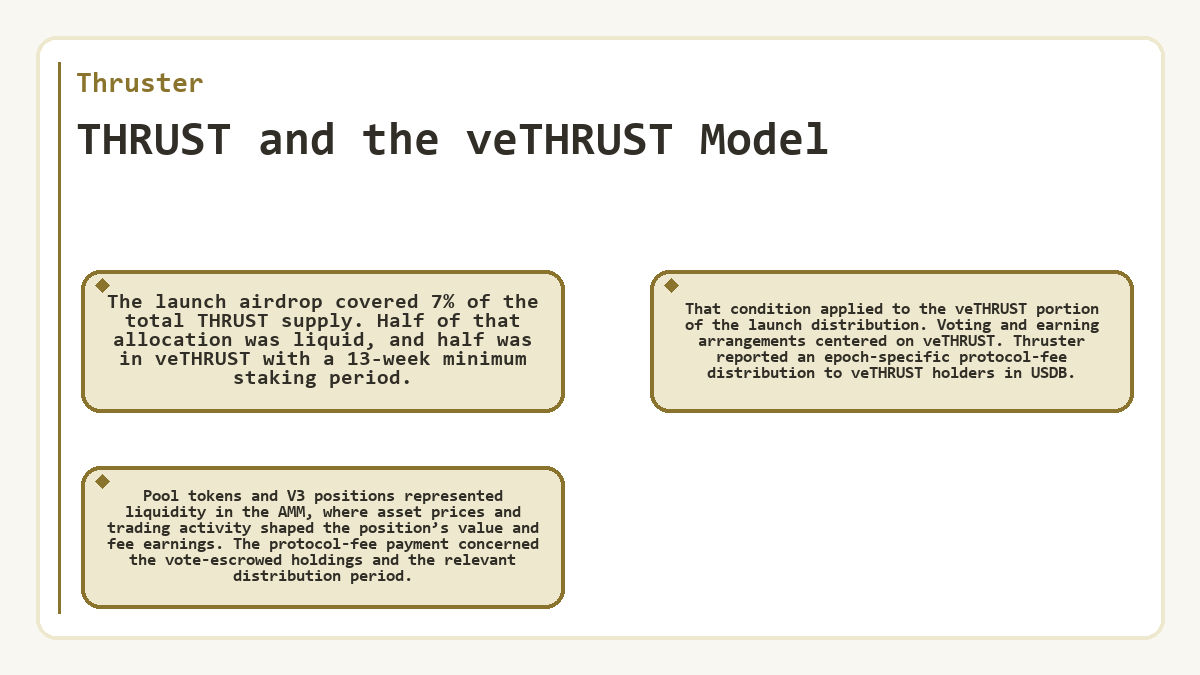
The launch airdrop covered 7% of the total THRUST supply. Half of that allocation was liquid, and half was in veTHRUST with a 13-week minimum staking period. That condition applied to the veTHRUST portion of the launch distribution.
Voting and earning arrangements centered on veTHRUST. Thruster reported an epoch-specific protocol-fee distribution to veTHRUST holders in USDB. Pool tokens and V3 positions represented liquidity in the AMM, where asset prices and trading activity shaped the position’s value and fee earnings. The protocol-fee payment concerned the vote-escrowed holdings and the relevant distribution period.
Swap Fees and Historical Incentive Programs
The documented V2 routes included 0.30% and 1.00% swap-fee tiers. Those rates described fees on trades through their respective V2 pools; gas and price impact were separate cost inputs.
Blast Points and Blast Gold featured in the exchange’s incentive programs alongside trading fees. Optional partner integrations included Hyperlock, Particle, and Juice, which supported LP positions in different ways. Deposits could bring additional incentives or yield when the partner supported the relevant LP position and the applicable program’s conditions were met.
The Announced Wind-Down and Token Redemption
Thruster announced a wind-down and redemption for token holders. Its announcement also referred to final emissions and fee distribution. These were announced wind-down measures, distinct from a confirmation that every individual holder had received a payment.
Removing liquidity concerned the underlying assets of a V2 or V3 position. Token-holder redemption concerned THRUST and related holdings under the announced wind-down arrangement.
Contract-Based Liquidity Removal
Blastscan provided the documented contract-access method for removing V2 or V3 liquidity outside the exchange interface. The selected pool version determined the relevant contract, authorization, and parameters.
V2 LP Tokens and the Matching Router
The V2 method used LP-token approval for the router matching the pool’s fee tier. The removal function depended on the assets involved, including whether the holder wanted native ETH from an ERC-20/WETH pool. Its liquidity parameter identified the LP-token amount to remove. Minimum-output parameters limited the acceptable asset amounts, and the recipient field identified where the underlying assets went.
V3 Liquidity and Token Collection
The V3 method identified a position by its token ID and read its liquidity amount. The documented Blastscan method required collecting tokens after decreasing V3 liquidity to return the withdrawn assets to the recipient. The collection recipient needed to be the intended wallet. A liquidity reduction alone didn’t establish receipt of those tokens.
Minimum outputs and transaction deadlines constrained the documented removal methods. Setting one asset’s minimum output to zero removed that asset’s minimum-receipt constraint. The deadline was a Unix timestamp after which the transaction would revert. These parameters belonged to the particular position and transaction; copying values from a historical illustration could target the wrong amounts or an expired deadline.
Swap Records and Existing Holdings
- For a swap record, identify the pool fee separately from gas and execution-price changes.
- For a V2 LP balance, identify the pool’s fee tier before selecting a removal router.
- For a V3 position, distinguish remaining liquidity from tokens available for collection.
- For an out-of-range V3 position, separate retained assets from new trading-fee accrual.
- For a THRUST allocation, distinguish launch-airdrop terms from the later wind-down redemption announcement.
A V2 LP token represented a pool share. Liquid THRUST represented project-token ownership, with redemption terms distinct from the pool’s withdrawal method.
Key questions about Thruster
Did the Launch airdrop’s 90-Day Window Apply to wind-down Redemptions?
The 90-day claim window applied to the original THRUST launch airdrop, so it didn’t set a deadline for the separate token-holder redemption announced during the wind-down.
Could a Wallet Hold Multiple V3 Positions in the Same Pool?
The concentrated-liquidity design allowed multiple positions within a single pool. Each position could use its own price range, so sharing a pool didn’t make every position active at the same prices. Their ranges could create different trading-fee exposure even though they involved the same underlying asset pair.
Were Blast Points and Blast Gold Reduced by Protocol Fees?
Thruster charged no protocol fee on the Blast Points or Blast Gold liquidity providers earned. Swap fees and network gas remained separate costs, and deposits through partner protocols involved the relevant partner program’s terms.
Was WETH Unwrapping Compulsory After a V3 Withdrawal?
Unwrapping was optional when a V3 withdrawal left WETH in the wallet and the holder wanted native ETH. The separate operation used the WETH contract’s withdraw function to convert that WETH balance into ETH, after decreasing liquidity and collecting tokens.
Which V2 Removal Function Handled Tokens With Transfer Fees?
The documented V2 ERC-20/WETH route returning native ETH included removeLiquidityETHSupportingFeeOnTransferTokens for tokens that charged a transfer fee. This function covered that asset and output combination. The applicable router still depended on the pool’s fee tier.
How Did Hyperlock Connect HYPER Locking With veTHRUST?
Hyperlock’s launch-period model let HYPER lockers participate through Hyperlock’s veTHRUST holdings. The associated benefits included directing THRUST emissions and receiving voting incentives. Participation through that partner arrangement involved HYPER and Hyperlock’s veTHRUST, with different conditions from direct ownership of liquid THRUST.
What Else Could Developers Build on Thruster’s concentrated-liquidity Design?
Thruster’s range-based AMM could support automated liquidity managers, limit-order-style strategies, and products with options-like payoffs. Each required an implementation beyond the underlying pool. These were applications enabled by the design, with a particular product’s availability depending on its own integration.